
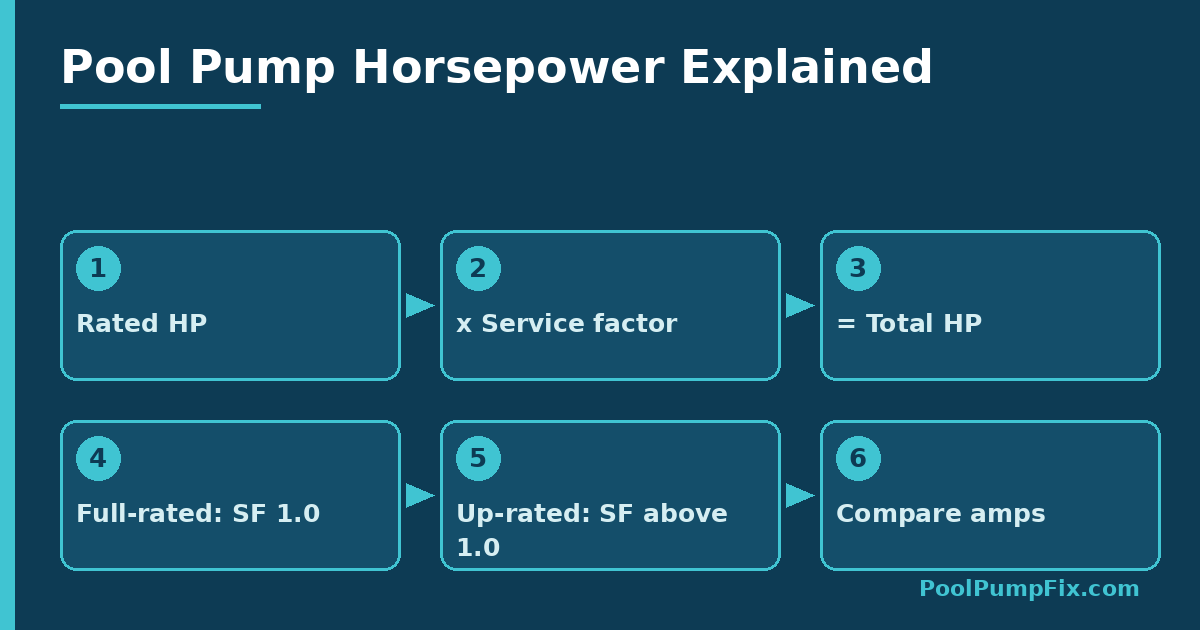
Quick Answer: Pool pump horsepower is not always what it seems. Service factor tells you how far above its rated horsepower a motor can run, and total horsepower is the rated horsepower multiplied by the service factor. A full-rated motor has a service factor of 1.0, while an up-rated motor is built smaller and marketed by its total horsepower.
- Cost: Free
- Difficulty: Easy
- Time Needed: 10 minutes
- Tools: Motor nameplate
If two pumps both say 1.5 HP and one costs far less, the nameplate usually explains why. This article helps you read the numbers. For sizing the pump to your pool rather than just comparing motors, see what size pool pump do I need.
What Service Factor Means
Service factor is a multiplier that describes how much overload a motor can handle for short periods. A motor with a service factor of 1.0 should be run at or below its rated horsepower. A motor rated 1 HP with a service factor of 1.5 can handle up to 1.5 HP of load, but running at that level makes more heat and wears the motor faster.
Total Horsepower
Total horsepower (THP) is rated horsepower multiplied by service factor. A 1 HP motor with a 1.5 service factor is sold as 1.5 THP. The number on the box looks bigger, but the motor underneath is the smaller one.
Full-Rated vs Up-Rated
- Full-rated: Service factor around 1.0. The horsepower on the label is the actual rated horsepower. These are typically more robust and run cooler at the same load.
- Up-rated: Smaller motor with a higher service factor. It can produce the headline horsepower, but it runs closer to its limit.
Why It Matters for Repairs
An up-rated motor that works near its limit can run hotter and draw more amps, which can shorten its life. Compare amp draw on the nameplate and read pool pump amp draw for how to check it. When replacing a motor, match the original specification. See motor frame sizes.
Horsepower Is Not Wattage
Electrical input is measured in watts, and it is higher than the horsepower output because the motor is not perfectly efficient. For the running cost of different pumps, see pool pump electricity cost, and for the energy advantages of different designs read single speed vs variable speed.
Step-by-Step: Read the Nameplate
- Find the horsepower rating and the service factor (SF) on the nameplate.
- Multiply them to get total horsepower.
- Note the full-load amps and voltage.
- Compare motors by amps and rated horsepower, not just the headline number.
When to Call a Professional
If you are buying a pump for a pool with heavy plumbing, a heater or water features, ask a pool professional to size it. The pump has to match the system, not just the horsepower on the box.
Prevention Tips
- Do not shop by total horsepower alone.
- Compare the amp rating and service factor on the nameplate.
- Match a replacement motor to the original specifications.
FAQ
What is a good service factor for a pool pump motor?
A service factor of 1.0 means the motor is full-rated and should not be run above its listed horsepower. A higher number, such as 1.5, usually means an up-rated motor that is sold on its total horsepower, so compare the amps and rated horsepower too.
Is total horsepower the same as rated horsepower?
No. Total horsepower is rated horsepower multiplied by service factor, so it is always equal to or higher than the rated number.