
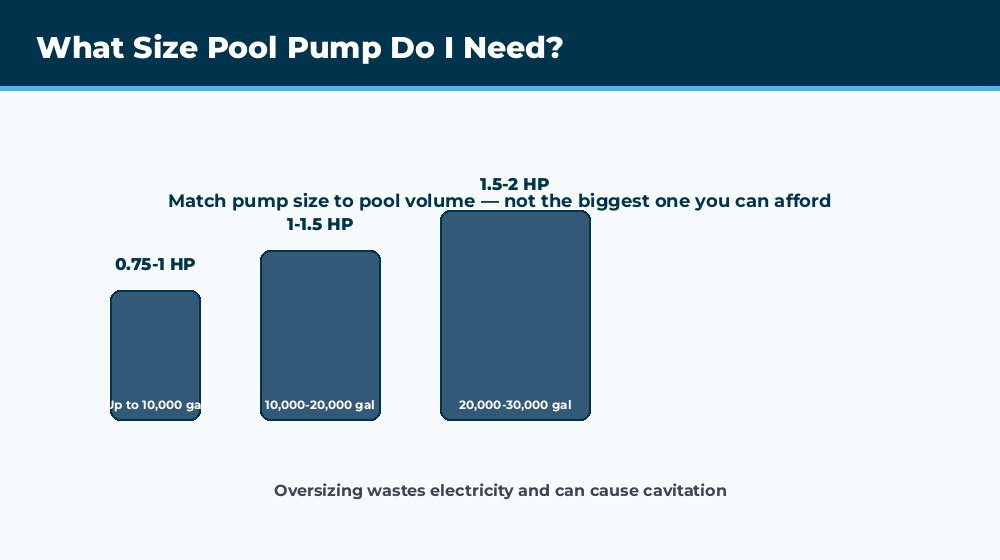
Match your new pump’s HP and flow rate to your existing plumbing and pool volume — not just to the size of pump you can afford. Most residential pools up to 20,000 gallons run correctly on a 1–1.5 HP pump. Bigger isn’t better: an oversized pump creates excess pressure, wastes electricity, and can cavitate against undersized plumbing.
The Single Biggest Mistake — Buying Too Big
I see this constantly: someone assumes a bigger HP pump will clean their pool faster or better, so they buy 2 HP when 1 HP would have done the job. The result is an oversized pump fighting the existing plumbing, running at higher pressure than necessary, costing more in electricity, and sometimes cavitating because the pipes can’t deliver enough water to satisfy the bigger impeller’s demand. Size to your actual needs, not your budget ceiling.
Practical field-tested method for sizing a pool pump by matching current performance and pool requirements.
Step 1: Know Your Pool Volume
Rectangular pools: Length × Width × Average Depth × 7.5 = gallons. Circular pools: Diameter × Diameter × Average Depth × 5.9 = gallons. If you don’t know your pool’s exact dimensions, your pool builder’s paperwork or a quick measurement gets you close enough for pump sizing purposes.
Step 2: Match HP to Pool Size
| Pool Size | Recommended Single-Speed HP | Recommended VS Pump |
|---|---|---|
| Up to 10,000 gallons | 0.75–1 HP | 1.5–2.7 HP VS (runs at low speed) |
| 10,000–20,000 gallons | 1–1.5 HP | 1.5–2.7 HP VS |
| 20,000–30,000 gallons | 1.5–2 HP | 2.7 HP VS |
| 30,000+ gallons or with water features | 2–3 HP | 2.7–3.4 HP VS |
Note that VS pump HP ratings are higher than equivalent single-speed because the VS pump only uses full HP at maximum speed — it runs most of the time at a fraction of that, which is where the energy savings come from.
Step 3: Check Your Existing Plumbing Size
This is the step most buying guides skip and it matters enormously. Measure your suction and return pipe diameter at the pump. If it’s 1.5-inch pipe, don’t buy a 2+ HP pump without also upsizing the suction plumbing — the pipe can’t deliver enough water to the bigger pump and you’ll get cavitation. A pump’s rated flow only happens with adequately sized plumbing feeding it. See our flow rate calculation guide for the full GPM math.
Step 4: Decide Single-Speed, Two-Speed, or Variable-Speed
Single-speed: lowest purchase price, highest electricity cost over time. Right for very short swim seasons or extremely tight budgets. Two-speed: middle ground, lower cost than VS, meaningful electricity savings running on low speed most of the time. Variable-speed: highest purchase price, lowest electricity cost by far, quietest operation, best choice for most situations where the pool runs more than a few months per year. See our full single vs variable speed comparison for the complete cost breakdown.
Special Cases That Change Sizing
Solar heating: add roughly one HP size over filtration-only requirements — see our solar pump sizing guide. Water features (waterfalls, spillover spas): typically need a dedicated booster pump rather than upsizing the main pump. Spa attached to the pool: may need its own pump or a higher-capacity VS pump that can run at high speed for spa jets and low speed for pool filtration.
Frequently Asked Questions
Is a bigger HP pool pump always better?
No. An oversized pump for your plumbing wastes electricity, runs at unnecessarily high pressure, and can cause cavitation if the suction plumbing can’t supply enough water. Match HP to your actual pool volume and plumbing size, not to the biggest pump in the store.
What HP pool pump do I need for a 20,000 gallon pool?
A 1.5 HP single-speed pump handles a 20,000-gallon pool comfortably for standard filtration, assuming reasonably sized plumbing (2-inch suction recommended at this size). A 1.5–2.7 HP VS pump running mostly at low-medium speed is the better choice for energy efficiency.
Should I match the new pump exactly to my old pump’s HP?
Usually yes, if the old pump was performing adequately. If you were having chronic flow or clarity problems with the old pump, that’s worth investigating before assuming you need more HP — often the issue was maintenance-related (dirty filter, clogged basket) rather than undersizing.
Can I oversize my pump now in case I add a water feature later?
Generally not recommended. It’s better to size correctly for current needs and add a dedicated booster pump when you actually add the feature, rather than running an oversized main pump in the meantime at unnecessary electricity cost.
How do I know if my current pump is the wrong size?
Signs of undersizing: water takes more than 12 hours to turn over once, persistent clarity issues despite correct chemistry and clean filter. Signs of oversizing: pressure gauge always reads high even with a clean filter, return jets disturb the water surface excessively, audible cavitation noise.