
A pool cover pump is a small submersible unit that sits on top of your winter cover and removes rainwater and snowmelt — it has nothing to do with your main circulation pump. The most common failure: air lock (the pump runs but doesn’t move water) or a stuck float switch. Both fix in under 10 minutes with no tools.
This Is a Different Pump Than Your Pool Pump
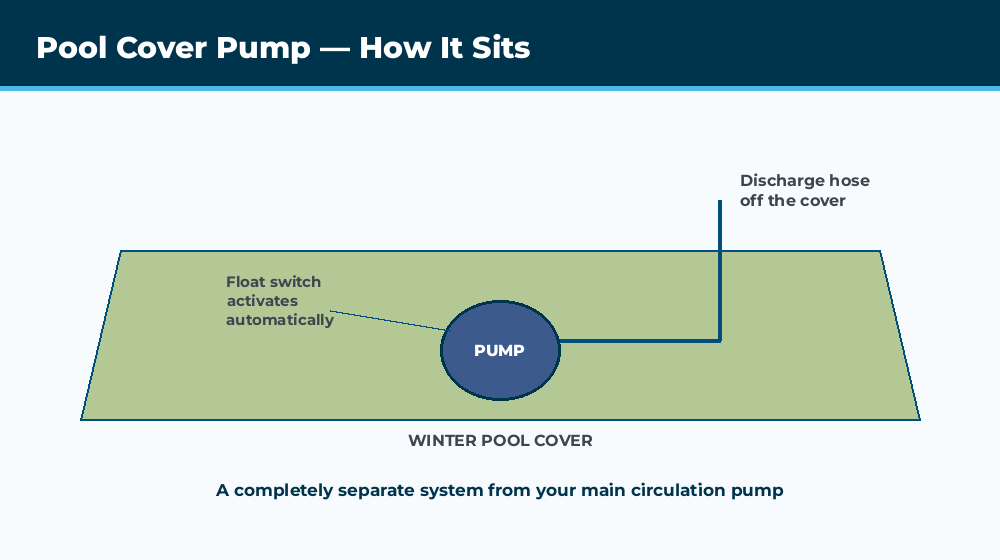
I want to be clear about this distinction because it causes confusion: your main pool pump circulates water through the filter and runs on a timer year-round (or is winterized and shut down). A pool cover pump is a small, separate submersible unit — usually 1/4 to 1/3 HP — that sits directly on top of your winter cover and automatically pumps off rainwater and melted snow so the cover doesn’t sag, tear, or let water into the pool. They’re unrelated systems with completely different troubleshooting.
Common pool cover pump failures — clogging, weak power, and float switch issues — diagnosed and fixed step by step.
Pump Runs But No Water Comes Out — Air Lock
This is the single most common cover pump complaint. The pump motor runs (you can hear it) but no water exits the discharge hose. Air gets trapped in the pump housing and the impeller spins in air instead of pulling water. Fix: lift the pump slightly out of the water and let air bubble out, or tilt it back and forth a few times while submerged to purge the air pocket. Some models have a small weep hole near the base specifically to prevent air lock — if it’s clogged with debris, clean it with a pin or wire.
Pump Won’t Turn On At All
Most cover pumps use an automatic float switch that activates when enough water accumulates. Test it directly: submerge the pump in a bucket of clean water — if it starts, the switch and motor are fine and the issue is with how it’s sitting on the cover (not enough water depth to trigger the float, or the float is physically obstructed by the cover fabric). If it doesn’t start even in a bucket, check the outlet (press any GFCI reset button nearby) and check the cord for damage. Rainwater with very low mineral content occasionally doesn’t conduct well enough to trigger conductivity-style switches — test with tap water specifically if you suspect this.
Clogged Intake — Most Preventable Problem
Leaves, debris, and small insects clog the intake screen at the bottom of the pump. A clogged intake reduces flow dramatically or stops it completely. Remove the pump’s screen cover, clean out debris with a soft brush, rinse, and reassemble. Check this every few weeks during fall leaf season — it’s the highest-frequency cover pump issue I see.
Cycles On and Off Repeatedly
If the pump short-cycles — turning on for a few seconds, then off, repeatedly — the float switch may be right at the threshold water depth, or debris under the cover is causing the pump to rock slightly and trigger the switch intermittently. Reposition the pump to a lower spot on the cover where water pools more consistently.
Doesn’t Shut Off When It Should
A pump that keeps running after the cover is dry usually has a stuck float switch (debris caught under the float arm) or, on electronic sensor models, corroded sensor contacts. Clean the float mechanism or sensor contacts with a soft brush and fresh water.
Prevention and Winter Storage
Clean the intake screen every 2–3 weeks during the off season. Never let the pump run dry for extended periods — most have thermal protection but repeated dry-running shortens motor life. At the end of winter, remove the pump, clean it thoroughly, dry it completely, and store it indoors in a temperature-controlled space rather than leaving it outside through summer heat.
Frequently Asked Questions
Is a pool cover pump the same as my main pool pump?
No — completely different equipment. Your main pump circulates and filters pool water and is typically a 1–2 HP unit on a timer. A cover pump is a small 1/4–1/3 HP submersible that sits on top of a winter cover and removes accumulated rainwater. They serve entirely different functions.
How do I fix a pool cover pump that runs but doesn’t pump water?
This is almost always air lock. Lift the pump partially out of the water to let trapped air escape, or tilt it to purge the air pocket from the housing, then resubmerge.
Can I leave my pool cover pump out year-round?
Not recommended. Extended sun and heat exposure degrades the seals and housing. Store it indoors when not actively removing water, and definitely bring it inside for the off-season once your cover is removed in spring.
Why does my cover pump only work in a bucket but not on the cover?
The float switch on the cover needs sufficient water depth to activate, or the cover fabric itself may be restricting the float’s movement. Reposition the pump to a spot with deeper, more consistent water pooling.
How long do pool cover pumps last?
3–7 years typically, with float switch failures being the most common end-of-life issue. Models with simple mechanical float switches tend to be more durable and easier to repair than electronic sensor models.