
Quick Answer: A power outage often trips the pump’s GFCI breaker even after the outage itself ends — the surge when power is restored is enough to trip it. Check the GFCI and main breaker before assuming the outage damaged the motor itself.
- Cost: Free (reset) to $15–$40 (breaker replacement)
- Difficulty: Easy
- Time Needed: 10–20 minutes
- Tools: None required, voltage tester helpful
This is specifically about a pump that worked fine before an outage and won’t restart after power returns. For general no-power troubleshooting unrelated to an outage, see my broader pool pump won’t turn on guide.
Check the GFCI Breaker First
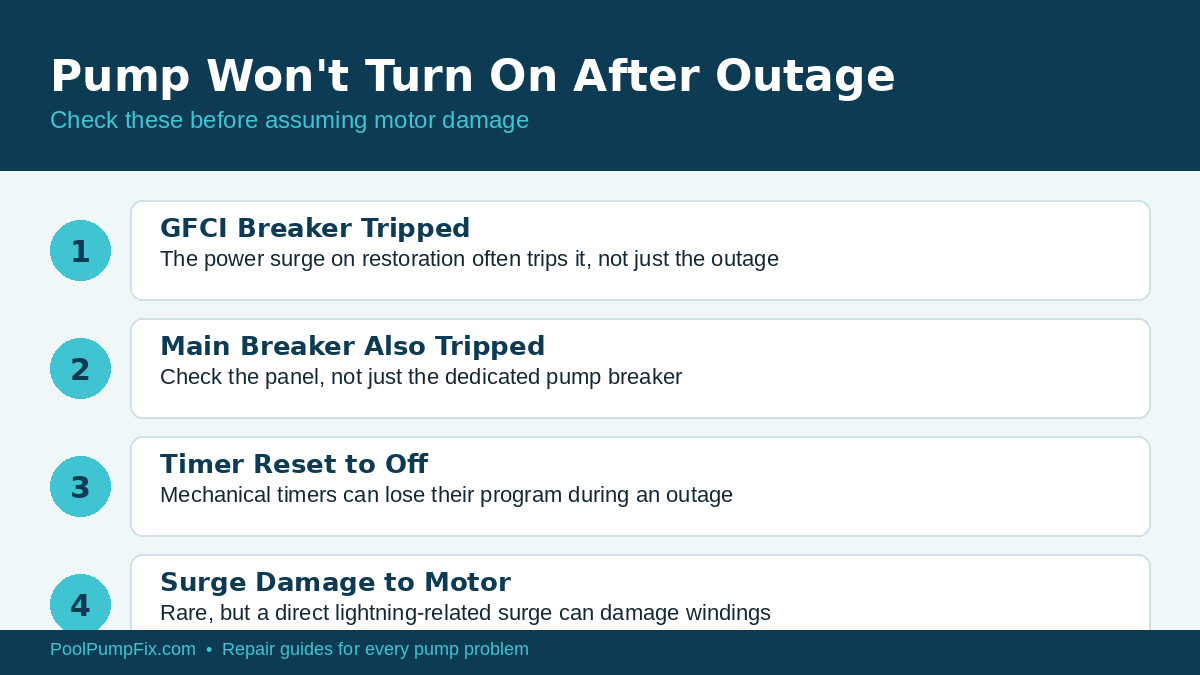
The moment power is restored after an outage, the sudden surge as everything on the grid comes back online is often enough to trip a GFCI breaker, even though the pump itself is completely fine. This is the single most common reason a pump won’t restart after an outage. Find the GFCI breaker (it will have a small test/reset button distinct from a standard breaker) and reset it firmly.
Check the Main Breaker Too
Don’t stop at the pump’s dedicated breaker — outages and power restoration surges can trip other breakers in the panel as well, including a main disconnect if your system has one. Walk the full panel and look for any breaker sitting in a middle position between fully on and fully off, which indicates a trip rather than an intentional off.
Check the Timer Settings
Mechanical (dial-style) pool timers can lose their time-of-day setting during a power outage, especially longer outages, and some models default to an “off” program state until manually reset. Confirm the timer’s current time matches actual time, and that the on/off pins or digital schedule are still set correctly — it’s easy to assume the pump is broken when it’s actually just waiting for its next scheduled “on” cycle that got shifted by the outage.
Rule Out Surge Damage
If the outage was caused by a lightning strike nearby, rather than a routine utility issue, there’s a small but real chance the surge damaged the motor windings or a control board (on variable-speed pumps) directly. This is uncommon compared to a simple GFCI trip, but worth considering if resetting breakers doesn’t restore power to the pump at all — no hum, no click, completely dead.
Step-by-Step Checklist
- Locate and reset the GFCI breaker dedicated to the pool equipment.
- Check every breaker in the main panel for a mid-position trip indication.
- Confirm the timer’s time-of-day and schedule are still correct.
- Test for voltage at the pump with a multimeter if it still won’t run after resetting breakers.
- If there’s confirmed voltage but the pump is still dead, the outage likely wasn’t the cause — treat it as a separate motor issue.
When to Call a Professional
If the GFCI won’t hold a reset at all, or you suspect surge damage from a lightning-related outage, have an electrician confirm the breaker and wiring are sound before you keep cycling power to the pump — repeated resets on a genuinely faulted circuit risk further damage.
Prevention Tips
- Consider a whole-home or dedicated surge protector on the pool equipment circuit if outages and storms are frequent in your area.
- Note your timer’s schedule settings somewhere handy (photo on your phone works) so resetting it after an outage takes seconds, not guesswork.
- After any outage, make it a habit to walk the full breaker panel rather than only checking the pump’s dedicated breaker.
FAQ
Why would a power outage trip my pump’s breaker?
The surge that occurs when utility power is restored after an outage is often enough to trip a sensitive GFCI breaker, even without any damage to the pump itself.
My timer shows the wrong time after the outage — is that the problem?
Possibly — a mechanical timer with a wrong time-of-day setting may simply be waiting for its next scheduled cycle, which can look identical to a broken pump.