
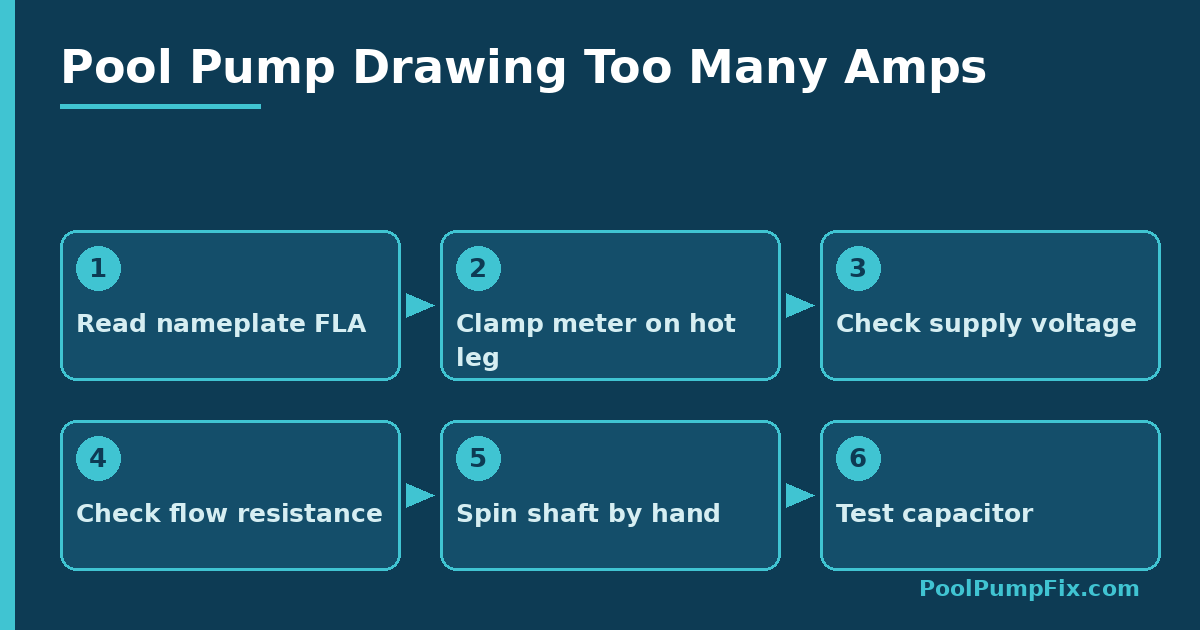
Quick Answer: Measure the pump’s running amps with a clamp meter and compare them to the full-load amps on the motor nameplate. A pump running above that number is working too hard, and the usual causes are worn bearings, low voltage, a failing capacitor or winding, wrong voltage wiring, or a pump moving too much water with too little resistance.
- Cost: Free to find, $100–$400 for motor
- Difficulty: Moderate
- Time Needed: 20–40 minutes
- Tools: Clamp meter, multimeter, screwdriver
High amp draw is the quiet cause behind a lot of tripped breakers and burned-out motors. If your breaker is already tripping, start with my tripping breaker guide, then come back here to find the cause.
How to Measure It
Put a clamp meter around one hot leg feeding the motor while the pump runs normally. Compare the reading to the nameplate. The full-load amps (FLA) is the expected draw under normal load, and some motors list service factor amps (SFA) as a higher limit. A pump sitting consistently above the nameplate number deserves attention. Be careful, because the motor is live while you measure.
Worn Bearings or a Dragging Rotor
Failing bearings add friction, and the motor draws more current to overcome it. You will often hear a growl or squeal. See my motor bearings guide.
Low Supply Voltage
When voltage drops, the motor draws more amps to deliver the same power, and it runs hotter. A long wire run, loose connections or heavy loads on the same circuit can cause this. Read pool pump wiring for what to check.
Too Much Flow, Too Little Resistance
A centrifugal pump works harder as it moves more water. If the filter is bypassed, the plumbing is oversized, or valves are wide open to a low-resistance path, the pump can run above its rated load. Restricting flow slightly with a valve on the discharge side is a common way to bring the load back, but check the pump manufacturer’s guidance first.
Electrical Faults in the Motor
A weak capacitor, a shorted winding or a motor wired for the wrong voltage can all raise the amps. A dual-voltage motor wired for 115V but running on a weak supply draws roughly double the current of the same motor at 230V.
Step-by-Step: Find the Cause
- Read the nameplate and write down FLA, SFA, and voltage.
- Measure running amps on a hot leg with a clamp meter.
- Measure voltage at the motor while it runs. Compare to the nameplate.
- Check the filter and valves for anything that makes the pump run at an unusually open, low-resistance condition.
- Spin the shaft by hand with the power off and listen for roughness.
- Test the capacitor and inspect the terminal board wiring.
When to Call a Professional
If amps are well over the nameplate with normal voltage and free-spinning bearings, the motor windings are the likely cause. A motor shop can test them, but replacement is often the more economical fix.
Prevention Tips
- Re-check amps after any plumbing change, new filter or new valve.
- Keep connections tight and clean at the terminal board.
- Replace a weak capacitor before it fails.
FAQ
What amps should my pool pump draw?
Check the nameplate. The full-load amp rating for your specific motor and voltage is the number to compare against.
Can high amp draw burn out a pool pump motor?
Yes. Extra current produces extra heat, and sustained overloading shortens the life of the windings.