
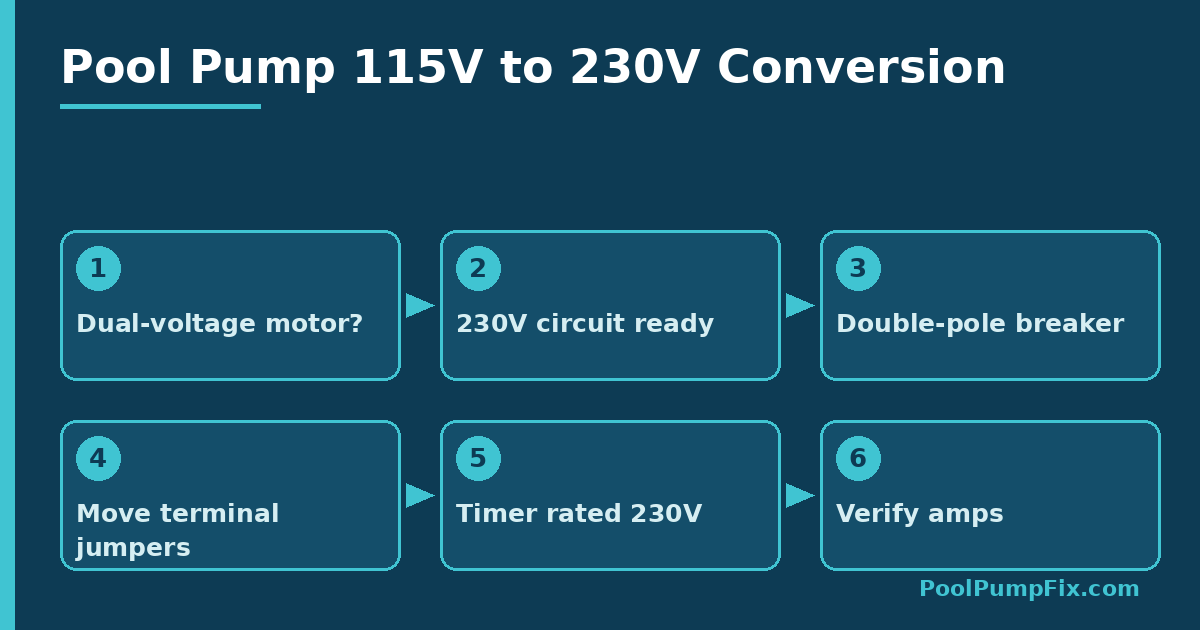
Quick Answer: Many pool pump motors are dual-voltage and can be set for 115V or 230V, either with a voltage selector switch or by moving jumpers on the terminal board, depending on the motor. Follow the nameplate diagram. 230V draws about half the current, but the circuit, breaker and wire all have to support it, so the conversion is a job for a qualified electrician unless you are experienced.
- Cost: Free to $300+ depending on the circuit
- Difficulty: Hard
- Time Needed: 1–3 hours
- Tools: Nameplate diagram, screwdrivers, multimeter, electrician
Running a pump on 230V puts less strain on the wiring and often helps with voltage drop, which is why it is a popular upgrade. It is not something to do casually. The motor wiring and the supply circuit both have to change, and local electrical codes apply. For the basics, start with my pool pump wiring guide.
Check That the Motor Is Dual-Voltage
Look at the nameplate. A dual-voltage motor lists both voltages, such as 115/230V, and shows a wiring diagram for each. If the motor lists only one voltage, it cannot be converted. Do not guess from the horsepower or the brand.
Why 230V Is Easier on the System
For the same power, doubling the voltage cuts the current roughly in half. Lower current means less heat in the wire and less voltage drop over a long run. If your pump struggles on 115V, see high amp draw for the symptoms.
What Has to Change
- The motor wiring: Set the voltage selector or move the jumpers on the terminal board per the nameplate diagram for 230V.
- The breaker: A 230V circuit uses a double-pole breaker.
- The supply wiring: Wire gauge, grounding and any required GFCI protection must meet code for the new circuit.
- The timer or control: Make sure it is rated for 230V.
The Mistake to Avoid
Never connect a motor wired for 115V to a 230V supply. The motor can be destroyed on the first start. Always confirm the jumper positions on the terminal board and the supply voltage before power goes back on.
Step-by-Step: How the Conversion Works
- Turn off power at the breaker and verify it is off with a meter.
- Read the nameplate and photograph the 115V and 230V wiring diagrams.
- Confirm the supply is a proper 230V circuit with the right breaker, wire and ground.
- Move the jumpers on the terminal board to the 230V positions.
- Check the timer or control for 230V compatibility.
- Restore power, run the pump, and confirm amps are within the nameplate rating.
When to Call a Professional
Hire a licensed electrician if the 230V circuit does not already exist, if you are unsure about GFCI requirements, or if you are not comfortable working in the panel. Pool electrical work has stricter rules than most household wiring.
Prevention Tips
- Label the terminal board and breaker with the voltage the pump is wired for.
- Keep the nameplate photo on your phone for future reference.
- Recheck amps and temperature after the conversion.
FAQ
Is 230V better than 115V for a pool pump?
It draws less current for the same power, which is easier on wiring and reduces voltage drop. The motor has to be dual-voltage to make the switch.
Can I just flip a switch to change a pool pump’s voltage?
On some dual-voltage motors, yes. Certain models have a built-in voltage selector. Others use jumpers on the terminal board, and the nameplate diagram shows which. Either way, the supply circuit, breaker and wire have to be ready for 230V first.