
Solar pool heaters add significant elevation and friction loss to your plumbing system — pushing water up to roof-mounted panels and back down requires more pump head than ground-level circulation alone. A pump correctly sized for filtration only is almost always undersized once solar panels are added, and the most common symptom is air bubbles or suction-side air leaks that appear specifically after solar installation.
Why Solar Heaters Change Your Pump Requirements
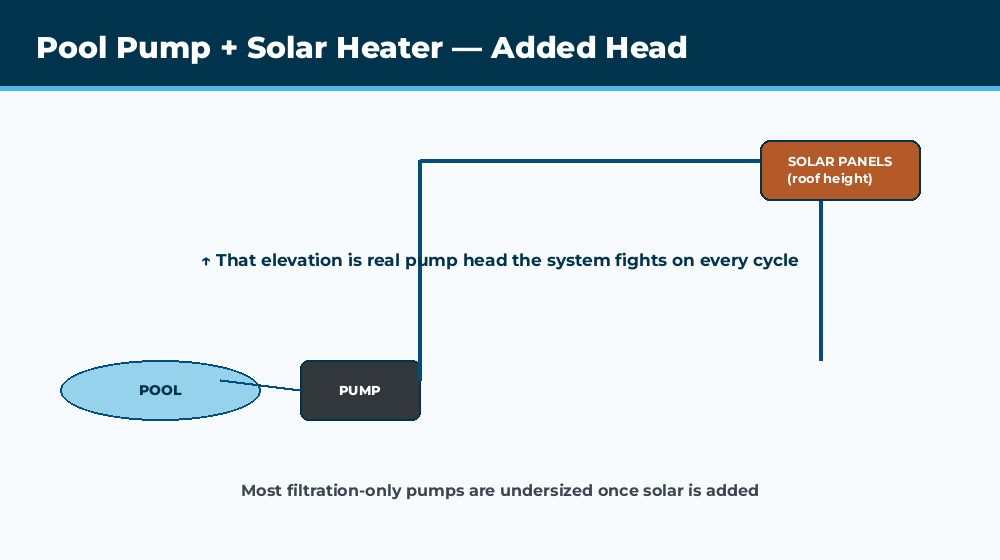
A standard filtration circuit moves water through ground-level plumbing with modest elevation change. Adding solar panels means the pump must also lift water to roof height (often 10–20+ feet) and push it through the added length and friction of the panel array before it returns to the pool. This significantly increases the total dynamic head (TDH) the pump has to work against.
I’ve diagnosed countless “air leak” complaints that turned out to be an undersized pump straining against solar plumbing — the pump pulls so hard on the suction side trying to overcome the added head that any minor suction-side imperfection becomes a major air leak symptom that wasn’t a problem before solar was added.
Solar pool heater installation showing panel connection to the pump circuit and the diverter valve setup — the additional plumbing load that affects pump sizing.
How Much Bigger Does the Pump Need to Be?
As a rule of thumb, plan for one size step up from what filtration alone would require. If your pool would normally run fine on a 1 HP pump for filtration, budget for 1.5 HP with solar added. For roof-mounted panels more than 15 feet above the pump, or for larger panel arrays, a 2 HP or variable-speed pump set to a higher flow rate during solar operation is often necessary.
The exact requirement depends on: roof height above the pump, total length of solar plumbing runs, panel array size and internal resistance, and existing pipe diameter. A pool professional with a solar-specific design (most solar installers provide this) will calculate exact TDH requirements — but the one-size-up rule gets most residential installations close.
The Suction Pipe Upsize Trick
If you don’t want to replace the entire pump, upsizing the suction-side plumbing from 1.5-inch to 2-inch pipe between the valves and the pump reduces friction loss significantly and can sometimes solve the air-leak-after-solar problem without a full pump replacement. This works best when the pump itself has reasonable headroom and the suction pipe was the actual bottleneck.
Diverter Valve and Plumbing Configuration
Solar systems use a 3-way diverter valve to route water either through the solar panels or bypass them, usually controlled automatically based on panel temperature versus pool temperature. A diverter valve that’s stuck or malfunctioning can create the same symptoms as an undersized pump — check that it’s actuating correctly before assuming pump sizing is the issue.
Signs Your Pump Is Undersized for Solar
Air bubbles or cavitation that started specifically after solar installation, water taking noticeably longer to circulate through panels, weak flow at returns when solar is active versus when it’s bypassed, and the pump running hotter or louder when solar is engaged. Any of these combined with a recent solar install points to a sizing mismatch rather than a mechanical pump failure.
Frequently Asked Questions
Do I need a bigger pump for solar pool heating?
In most cases, yes — solar systems add elevation and plumbing friction that a filtration-only pump sizing doesn’t account for. Budget one HP size larger than you would for filtration alone, more for roof heights over 15 feet or larger panel arrays.
Can I use my existing pump with new solar panels?
Sometimes, if the existing pump has some headroom above minimum filtration requirements and the panel array is modest. Test it after installation — if you see new air leak symptoms, cavitation, or weak flow through the panels, the pump needs upsizing.
What size suction pipe do I need for a pool with solar heating?
2-inch suction pipe between the pump and the valves is recommended for most solar-equipped systems, even on pumps that would be fine with 1.5-inch for filtration alone. The reduced friction loss helps the pump handle the additional solar head.
Why does my pool get air bubbles only when the solar heater is running?
This strongly suggests the pump is working harder than normal to push water through the solar circuit and is straining suction-side connections that hold fine under normal filtration load. Check for a marginal air leak that solar load is exposing — see our air bubbles guide — and consider whether the pump itself needs upsizing.
Does a variable-speed pump work well with solar heating?
Yes, often better than single-speed — you can program a higher speed setting specifically for when the diverter valve routes water through the solar panels, and a lower speed for standard filtration when solar is bypassed. This optimizes both performance and energy cost.