
Most residential pool pump warranties cover the motor for 1–3 years and the wet end housing for a separate, often longer period. Freeze damage, improper installation, and unauthorized DIY repairs on certain brands are common warranty exclusions. Register your pump and keep your purchase receipt — many claims get denied simply for lack of proof of purchase date.
Typical Warranty Structure
Most major brands (Hayward, Pentair, Jandy, Sta-Rite) split warranty coverage into two parts: the motor, typically covered 1–3 years depending on the model and whether it’s single-speed or variable-speed (VS pumps often get longer motor warranties, sometimes 3 years, reflecting their higher price point), and the wet end/housing, sometimes covered separately and for a different duration since it has fewer failure modes than the motor.
How home warranty policies and manufacturer warranties interact with pool equipment — what is typically covered and what is not.
What Commonly Voids a Pool Pump Warranty
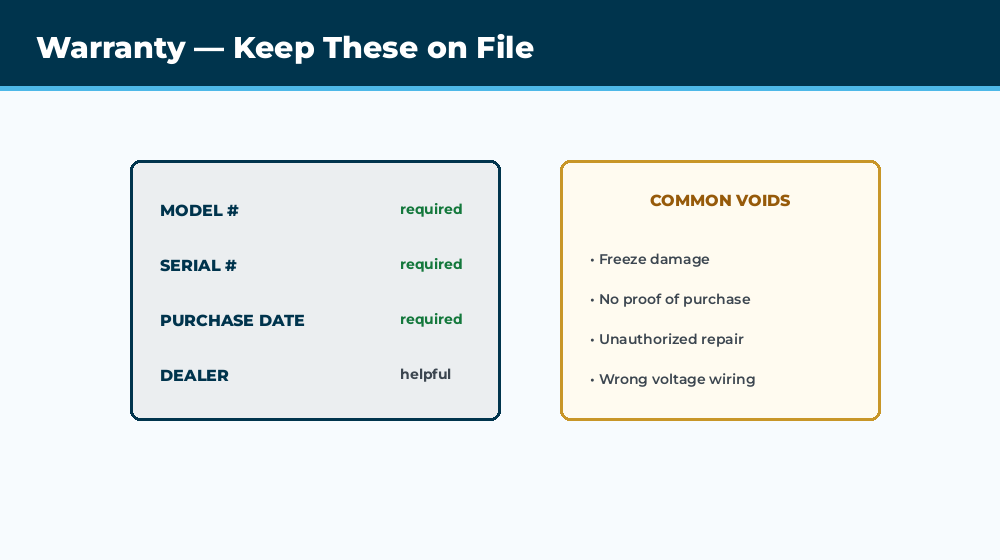
- Freeze damage — almost universally excluded across all manufacturers, since it’s considered a maintenance/winterization failure rather than a product defect. See our winterization guide to prevent this entirely.
- Improper installation — incorrect voltage wiring, missing GFCI protection, or installation by someone other than a licensed professional (required by some manufacturers for warranty validity)
- Unauthorized parts or DIY repairs — some manufacturers void remaining warranty if non-OEM parts were installed or if the pump was opened by someone other than an authorized technician; this varies significantly by brand, so check your specific terms before doing DIY work on a pump still under warranty
- Operating outside specified water chemistry — chronically out-of-range pH or chlorine levels causing component degradation can be cited as a maintenance failure rather than a covered defect
- Lack of proof of purchase — many claims are denied simply because the original receipt or registration wasn’t kept
How to Register Your Pump
Most manufacturers want online registration within 30–90 days of purchase, requiring the model number, serial number, purchase date, and dealer/installer information. Registration isn’t always strictly required for coverage, but it significantly speeds up claims processing and removes any ambiguity about purchase date if you don’t have the original receipt years later.
How to File a Warranty Claim
Contact the manufacturer directly (not the retailer, in most cases) with your model number, serial number, and a description of the failure. Many manufacturers require diagnosis by an authorized dealer or technician before approving a parts replacement — DIY diagnosis alone sometimes isn’t sufficient documentation. Keep any failed parts if requested, since some warranty processes require the defective component returned for inspection before a replacement ships.
Extended Warranties and Home Warranty Plans
Third-party home warranty companies (separate from manufacturer warranties) sometimes cover pool equipment, but coverage terms vary enormously and claim denials for pool equipment are a common complaint — read the specific pool equipment clause carefully before relying on one for pump coverage. Manufacturer warranties are generally more straightforward and reliable for pump-specific failures.
Frequently Asked Questions
How long is a typical pool pump warranty?
1–3 years on the motor for most brands, sometimes longer (up to 3 years) on variable-speed models. Wet end/housing coverage varies and is sometimes listed separately in the warranty terms — check your specific model’s documentation rather than assuming a universal term.
Does DIY repair void my pool pump warranty?
It depends entirely on the manufacturer and the specific repair. Simple maintenance (cleaning, O-ring replacement) rarely voids coverage. Opening the motor or replacing internal components yourself can void remaining warranty on some brands — check your specific terms before doing significant DIY work on a pump still under warranty.
Is freeze damage ever covered under warranty?
Almost never — freeze damage is treated as a maintenance/winterization failure across essentially every manufacturer, not a covered product defect. Prevention through proper winterization is the only real protection.
Do I need to register my pool pump for the warranty to be valid?
Registration requirements vary by manufacturer — some require it, others simply recommend it to speed up future claims. Keeping your original purchase receipt with the purchase date is the more universally important step, since that’s what establishes your warranty period regardless of registration status.
What should I do if my warranty claim gets denied?
Ask specifically which clause the denial is based on and whether documentation (photos, technician diagnosis, water chemistry logs) could change the outcome. If you believe the denial is incorrect, escalating to a supervisor or requesting a second review is reasonable — and working with the dealer who sold the pump can sometimes help mediate the claim.