
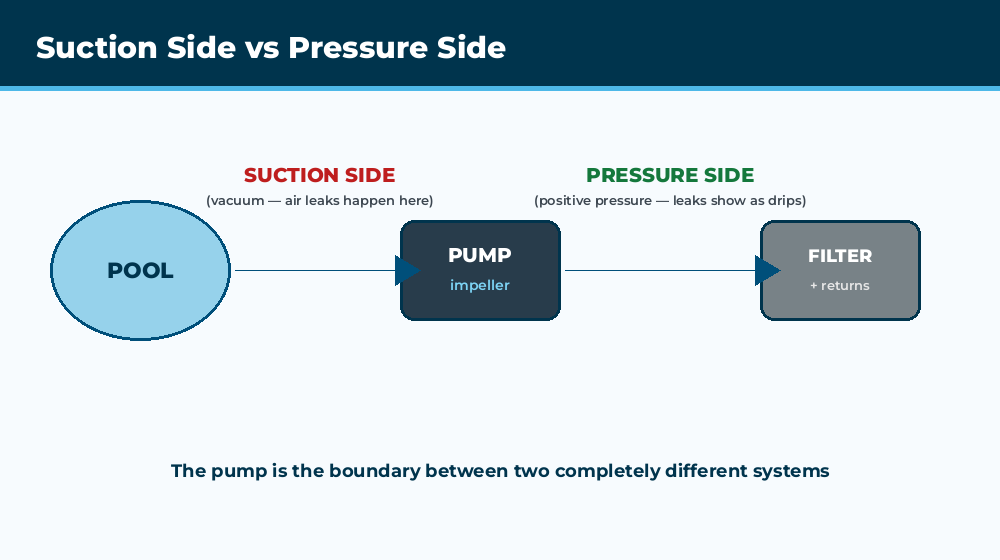
The suction side is everything from the pool to the pump inlet — skimmer, main drain, valves, and suction plumbing. The pressure side is everything from the pump outlet through the filter to the return jets. Air leaks and priming problems happen on the suction side. High pressure and blocked flow happen on the pressure side. Knowing which side your symptom is on cuts diagnosis time in half.
Why This Distinction Is the Foundation of Diagnosis
Every pool pump troubleshooting guide on this site eventually points back to this one concept. The pump sits at the boundary between two systems with completely different physics: before the pump, water is being pulled under vacuum (suction side); after the pump, water is being pushed under positive pressure (pressure side). Problems on each side look and behave differently, and understanding this immediately tells you where to look.
Direct explanation of what the suction side and pressure side of a pool actually are and how to identify each in your own system.
The Suction Side
Everything from the pool (skimmer, main drain) through the suction plumbing, suction valves, and into the pump inlet. The pump creates a vacuum here to pull water toward itself. Because it’s under vacuum rather than positive pressure, any opening — a cracked fitting, a bad O-ring, a loose union — pulls air IN rather than leaking water out. This is why suction-side problems show up as air bubbles, priming failures, and cavitation rather than visible leaks at rest.
Suction side problems include: priming failures, air bubbles in returns, losing prime after running, and cavitation.
The Pressure Side
Everything from the pump outlet through the filter, heater (if equipped), and return plumbing back to the pool. Water here is under positive pressure pushed by the pump. Because pressure is positive rather than vacuum, problems here show up differently — as visible water leaks at fittings, as restricted flow showing high pressure on the gauge, or as weak return jets.
Pressure side problems include: high filter pressure, weak return jets, and most visible plumbing leaks downstream of the pump.
Where the Pump Itself Fits
The pump is the boundary point. Inside the pump, the impeller takes low-pressure suction-side water and accelerates it, and the diffuser converts that velocity into the positive pressure that pushes water through the pressure side. A pump problem (clogged impeller, worn diffuser, failing motor) affects both sides simultaneously — you’ll see suction-side symptoms (won’t prime) AND pressure-side symptoms (low pressure) at once if the pump itself is the cause.
Quick Diagnostic Test
Air bubbles, won’t prime, or losing prime over time → suction side. Visible water leak, high pressure gauge reading, or weak return jets with low pressure → pressure side. Both suction AND pressure symptoms together → the pump itself (impeller, diffuser, or motor) is the likely cause rather than a single-side plumbing issue.
Frequently Asked Questions
Which side is the filter on?
The pressure side. Water has already been pressurized by the pump before it reaches the filter, which is why filter pressure readings reflect pressure-side conditions and a dirty filter shows as high pressure.
Can a suction side problem cause high pressure?
Indirectly, rarely — a severe suction restriction reduces flow so much that pressure readings can drop rather than rise, since less water is moving through the system overall. High pressure almost always points to a pressure-side restriction, not a suction-side one.
Why do suction side problems cause air bubbles instead of leaks?
Because the suction side operates under vacuum (negative pressure relative to atmosphere), any opening pulls outside air IN rather than letting water OUT. The pressure side operates under positive pressure, so openings there push water OUT as visible leaks instead.
Is the main drain suction side or pressure side?
Suction side — the main drain, along with the skimmer, feeds water toward the pump under vacuum before the pump pressurizes it.
Where does a heater fit in this system?
On the pressure side, typically positioned after the filter and before the return jets, since it needs already-filtered water flowing under positive pressure to operate correctly.