
Quick Answer: The impeller is the spinning part that moves water; the diffuser is the stationary part that surrounds it and directs flow. The simplest way to tell which one is failing: if it spins with the shaft, it’s the impeller; if it’s fixed in place around the impeller, it’s the diffuser. Clogs usually point to the impeller, while cracking or dislocation usually points to the diffuser.
- Impeller: Rotates with the motor shaft, moves the water
- Diffuser: Stationary, surrounds the impeller and directs flow
- Fix Difficulty: Moderate (pump disassembly required either way)
- Time Needed: 30–60 minutes
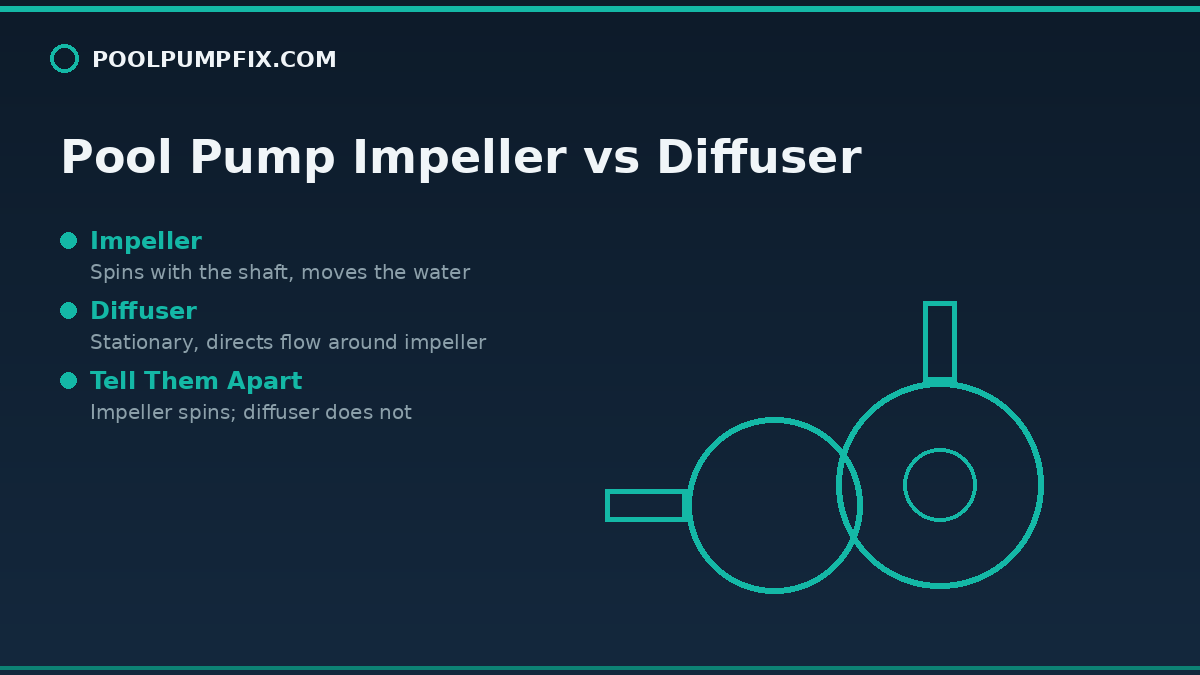
These two parts sit right next to each other inside the pump housing and get confused constantly, which makes sense. They work as a matched pair, and a problem with either one produces overlapping symptoms like weak flow or unusual noise.
What Each Part Actually Does
- The impeller is a rotor mounted directly on the motor shaft. It spins at nearly motor speed and physically flings water outward, converting the motor’s mechanical energy into water flow and pressure.
- The diffuser is a stationary piece that encloses the impeller. It focuses water into the impeller’s eye on the intake side and controls how flow exits on the discharge side using a series of fixed vanes — it never moves.
How to Tell Which One Is Failing
Symptoms That Point to the Impeller
- Debris clogging (grass clippings, pine needles, small pebbles) directly restricting flow.
- Visible wear or broken vanes on the rotating piece.
- Weak flow that improves noticeably once debris is cleared.
Symptoms That Point to the Diffuser
- Cracking from hard debris impact or freeze damage.
- The diffuser has become dislodged or shifted out of position inside the housing, which can cause grinding or a cavitation-like sound.
- Air leaks and reduced suction that persist even after the impeller is confirmed clear and undamaged.
Step-by-Step Diagnosis
- Power down and open the pump housing per your model’s service steps.
- Identify the impeller — it’s directly attached to the visible motor shaft and will spin if you turn the shaft by hand.
- Identify the diffuser — it surrounds the impeller and stays still even as you turn the shaft.
- Inspect each separately for cracking, wear, clogging, or improper seating.
How to Fix It
Impeller Issues
Clear debris from the vanes, and replace the impeller if vanes are cracked, worn thin, or if it wobbles on the shaft from worn threads.
Diffuser Issues
A cracked diffuser needs replacement; a dislodged one often just needs to be reseated correctly, with the “TOP” alignment marks matched to the seal plate.
When to Call a Professional
If you’re unsure which part is actually damaged after opening the housing, a pool technician can make the call quickly, and replacement parts for either piece are inexpensive relative to a full pump replacement.
Prevention Tips
- Keep the strainer basket in good condition — most debris that reaches the impeller does so through a cracked or missing basket.
- Handle the diffuser carefully during any service work, since it’s more prone to cracking than the impeller.
- Reseat the diffuser correctly with alignment marks matched every time the pump is opened.
FAQ
Can I replace just the impeller without touching the diffuser?
Yes, if the diffuser is undamaged — they’re separate parts and don’t need to be replaced together unless both show wear.
Does a bad diffuser cause the same symptoms as a bad impeller?
They can overlap (both cause weak flow), but a diffuser problem is more likely to also cause air-leak-like symptoms and unusual noise, while a clogged impeller more directly causes reduced flow with normal-sounding operation.