
If your pump runs normally and filter pressure is in range but return jets seem weak or won’t adjust direction, the problem is at the jet fitting itself — not the pump. Stuck or cracked eyeball fittings, mineral buildup, or a missing eyeball insert are the most common causes, and all are quick, cheap fixes.
Confirm It’s the Jet, Not the Pump or Filter
Before replacing any fittings, rule out upstream causes. Check your filter pressure — if it’s above your clean baseline, backwash or clean the filter first; high pressure reduces flow at every return jet equally. If pressure is normal and only one or two specific jets are weak while others are fine, the problem is local to those fittings.
Step-by-step pool return jet eyeball replacement — removal tool technique and reinstallation.
Eyeball Stuck and Won’t Rotate
The adjustable eyeball insert that lets you direct flow can seize from mineral scale buildup or simply age-related stiffening of the plastic. Try working it gently by hand first — sometimes a slow, persistent rotation breaks it free. If it won’t move, soak the area with a vinegar-soaked rag for 15–20 minutes to dissolve mild calcium buildup, then try again. A persistently stuck eyeball needs replacement.
Eyeball Missing or Fell Into the Pool
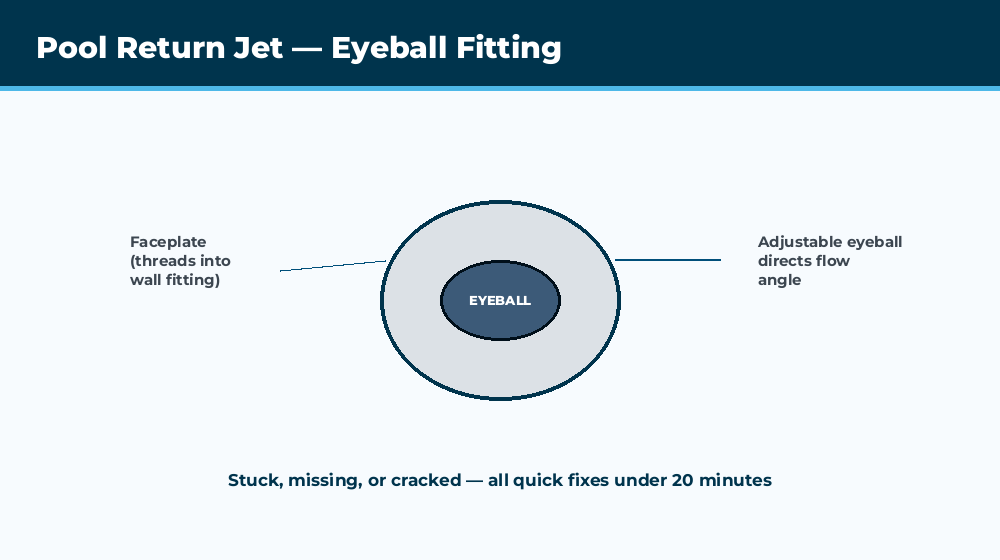
This happens more often than you’d think, especially on older installations where the eyeball has worn loose in its housing. Without the eyeball insert, water flows out unrestricted and undirected — you’ll notice a much weaker, unfocused stream. Replacement eyeball inserts are $5–10 and snap or thread into the existing faceplate housing — usually a tool-free fix.
Cracked or Broken Faceplate
UV exposure over years cracks the plastic faceplate that holds the eyeball assembly. A cracked faceplate can let water bypass around the eyeball, reducing directed flow and sometimes causing a slow leak behind the pool wall. Full return fitting replacement (faceplate plus eyeball plus gasket) runs $10–20 and requires a return fitting removal tool to unthread the old housing from the wall fitting.
Weak Flow at All Returns Simultaneously
If every return jet is weak at the same time, this points away from individual fittings and toward a system-wide cause: dirty filter, clogged impeller, suction-side air leak, or a closed/restricted valve. See our weak flow diagnosis guide for the full system-level troubleshooting.
Adjusting Return Jets for Better Circulation
Beyond fixing broken fittings, properly aiming your return jets improves overall pool circulation and reduces dead zones where debris and algae accumulate. Aim jets at a slight downward angle and in a circular pattern around the pool rather than straight across — this creates a rotational flow that reaches all areas more effectively than jets all aimed at the same direction.
Frequently Asked Questions
How do I remove a stuck pool return jet eyeball?
Try hand rotation first with steady, gentle pressure. If stuck from mineral buildup, soak with a vinegar-soaked rag for 15–20 minutes. For removal of the full fitting, a specialized return jet removal tool ($8–15) grips the inside notches; a large flathead screwdriver works on many models in a pinch.
Why is only one of my return jets weak?
Almost always a fitting-specific issue rather than a pump problem — a missing or stuck eyeball, mineral buildup restricting that specific jet, or a partially closed valve feeding that line if your system has zone valves. Check the individual fitting before assuming it’s pump-related.
Can I replace a return jet fitting myself?
Yes — it’s a straightforward DIY job. Most fittings thread into the wall fitting and don’t require draining the pool, since the threaded connection seals against the existing wall fitting with a gasket. Budget 15–20 minutes per fitting.
What’s the difference between a return jet and a return fitting?
“Return jet” and “return fitting” are generally used interchangeably to mean the same component — the wall-mounted outlet where filtered water returns to the pool, including the eyeball, faceplate, and gasket.
Should all my return jets point the same direction?
No — aim them to create circular or rotational flow around the pool rather than all parallel. This improves overall circulation and reduces dead zones where debris settles and chemicals don’t reach effectively.