
Quick Answer: If the pump primes fine but loses prime again within minutes or hours, the problem isn’t your priming technique — it’s a suction-side air leak pulling air in continuously while the pump runs. Check the pump lid o-ring, union gaskets, and skimmer/valve fittings in that order.
- Cost: $5–$30 (o-ring, gaskets, Teflon tape)
- Difficulty: Easy to Moderate
- Time Needed: 20–45 minutes
- Tools: Silicone lubricant, Teflon tape, flashlight
This is different from a pump that won’t prime at all the first time — if that’s your issue, see my general priming guide instead. This article is for a pump that primes successfully, runs fine for a while, and then loses prime again on its own.
Why It Keeps Losing Prime
A pump that primes and then loses it again — rather than never priming at all — is being fed a slow, continuous trickle of air from somewhere on the suction side of the system, between the pool and the pump impeller. Air in that section collects in the pump housing over time until there’s enough of it to break the water seal the impeller needs to maintain suction, at which point prime is lost. Finding the exact leak point is the whole job here.
Check the Pump Lid O-Ring First
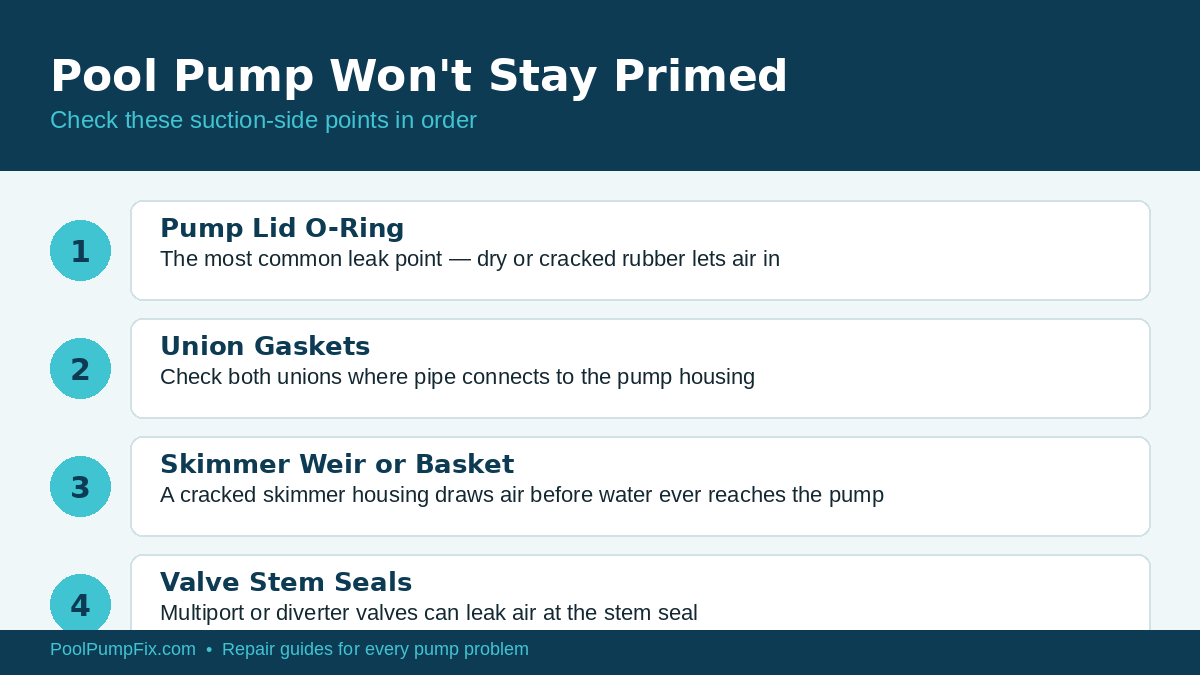
This is by far the most common culprit. The rubber o-ring under the pump lid dries out, cracks, or gets a bit of debris caught in it over time, letting a small but steady stream of air past the seal every time the pump runs. Remove the lid, inspect the o-ring for flat spots, cracking, or debris, and clean it thoroughly. A thin coat of silicone-based lubricant (never petroleum-based, which degrades rubber) on the o-ring often solves minor leaks immediately; a cracked or flattened o-ring needs full replacement.
Check Both Union Fittings
Most pumps have two unions — one on the suction side, one on discharge — where PVC pipe threads into the pump housing. The gasket inside each union can degrade or the union itself can loosen slightly over time from vibration. Hand-tighten each union firmly (over-tightening with tools can crack the plastic) and inspect the gasket for visible damage while you’re in there.
Check the Skimmer and Suction Line
A cracked skimmer housing, a loose skimmer basket, or a damaged suction-line fitting anywhere between the pool and the pump can pull air in before the water ever reaches the pump at all. This is a common source that gets overlooked because attention naturally focuses on the pump itself. Watch the skimmer during operation for visible air bubbles being drawn in around the basket or housing seams.
Check Valve Stem Seals
If your system has a multiport or diverter valve on the suction side, the valve stem seal can develop a slow air leak as the o-ring inside ages. This is a less common cause than the pump lid or unions but worth checking if those come up clean.
Step-by-Step Diagnostic Order
- Inspect and lubricate the pump lid o-ring — the highest-probability fix, done first.
- Hand-tighten both union fittings and inspect their gaskets.
- Watch the skimmer basket for visible air bubbles during a normal run.
- Check any suction-side valve stems for slow air leaks if the above come up clean.
- Re-prime and monitor for at least 30 minutes of continuous run time to confirm the fix held.
When to Call a Professional
If you’ve checked the lid o-ring, both unions, and the skimmer with no obvious leak found, the air entry point may be underground — a cracked suction pipe fitting buried in the yard — which typically needs a pool professional with pressure-testing equipment to locate.
Prevention Tips
- Replace the pump lid o-ring proactively every 1–2 years even if it looks fine — rubber degrades from UV and chlorine exposure regardless of visible cracking.
- Use only silicone-based lubricant on pool o-rings; petroleum-based products break rubber down over time.
- Hand-tighten unions after any pump maintenance — a union that’s snug today can loosen slightly from vibration over a season.
FAQ
Why does my pump prime fine but lose it again after an hour?
That pattern points to a slow suction-side air leak — most often the pump lid o-ring — rather than a priming technique issue.
Can a loose skimmer basket really cause this?
Yes — any gap on the suction side of the system, including a loose or cracked skimmer basket, lets air into the line before it reaches the pump.