
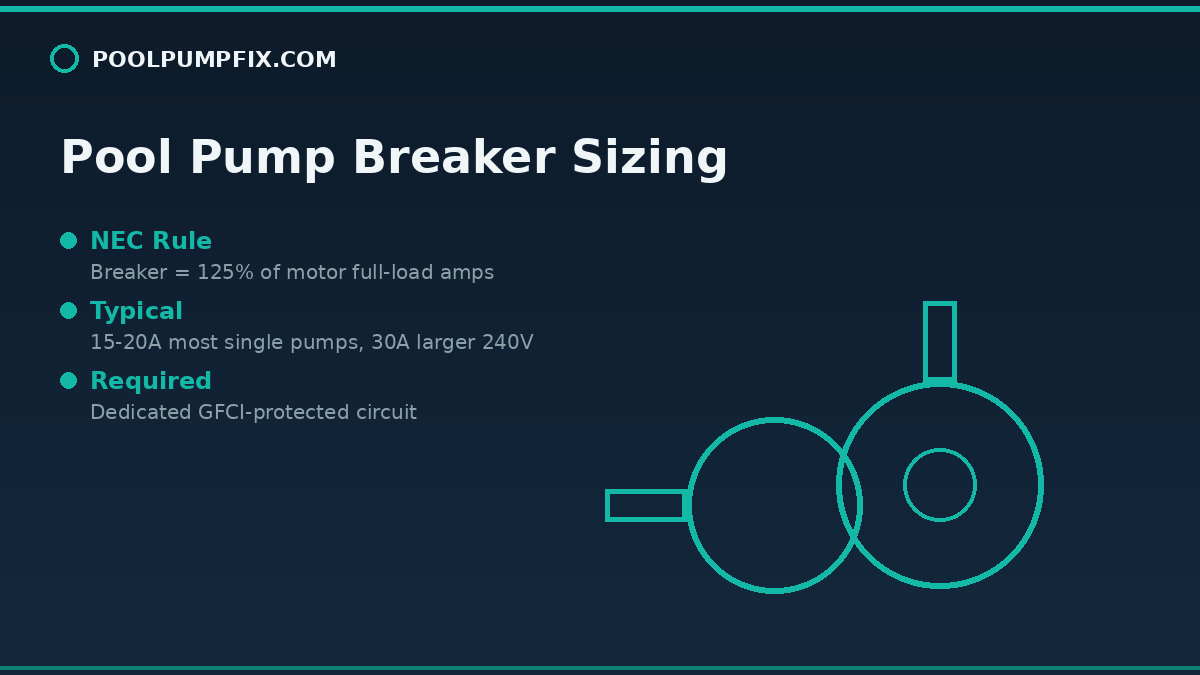
Quick Answer: Most residential pool pumps use a 15A or 20A dedicated, GFCI-protected circuit; larger inground pumps on 240V may need 20–30A. The sizing rule under NEC Article 430 is that the breaker should be rated at roughly 125% of the motor’s full-load amp (FLA) draw, not just matched to it exactly.
- Use Case: Sizing a breaker for a new pump install or replacement
- Typical Size: 15–20A for most single-speed pumps, 20–30A for larger 240V pumps
- Requirement: Dedicated circuit with GFCI protection
- Difficulty: Consult a licensed electrician for final sizing and installation
This question comes up any time you replace a pump with a different horsepower or wire a new installation. Undersize the breaker and you get nuisance tripping. Oversize it and the wiring is left underprotected.
How Breaker Sizing Actually Works
- The 125% rule: NEC Article 430 generally calls for a breaker sized at about 125% of the motor’s full-load amp rating to accommodate normal running current with headroom, not the momentary startup surge.
- Typical amp draw: Most residential pumps draw somewhere between 8 and 20 amps depending on horsepower and voltage — check the nameplate on your specific motor rather than assuming.
- Common breaker sizes: A 20A breaker with 12 AWG wire is common for most single pumps; larger 1.5–2HP 240V pumps often use a 30A breaker with 10 AWG wire.
- Above-ground vs inground: Above-ground pumps typically run on 120V with a 15–20A circuit; inground pumps more commonly run 240V and may need a larger breaker depending on horsepower.
What’s Required Regardless of Size
- A dedicated circuit for the pump — not shared with other loads unless specifically sized to accommodate them.
- GFCI protection is required by the National Electrical Code for pool pump circuits, whether via a GFCI breaker or a GFCI outlet.
- Wire gauge matched to the breaker — 12 AWG for 20A circuits, 10 AWG for 30A circuits, following standard ampacity tables.
How to Determine the Right Size for Your Pump
Check the Nameplate
The motor’s data plate lists its rated amperage — this is the number to work from, not a generic horsepower-to-breaker chart, since amp draw varies by manufacturer and voltage configuration.
Account for Voltage Drop on Long Runs
If the run from panel to pump is long, voltage drop can effectively increase current draw — a licensed electrician can calculate whether a larger wire gauge is needed even if the breaker size itself doesn’t change.
Don’t Oversize “Just in Case”
A breaker larger than what the wire gauge is rated for creates a fire risk — the breaker’s job is to protect the wire, not just the pump, so sizing has to match the whole circuit, not just the motor.
When to Call a Professional
Breaker and wire sizing should always be confirmed by a licensed electrician against your specific pump’s nameplate rating and local code requirements — this article explains the principles, not a substitute for a proper load calculation on your installation.
Prevention Tips
- Keep the pump’s nameplate data plate legible and accessible for future reference.
- Don’t replace a pump with a significantly higher-horsepower model without rechecking breaker and wire sizing.
- Test GFCI protection monthly using the built-in test button.
FAQ
Can I use a 20A breaker for a pump that only draws 10A?
Yes — the breaker protects the wire, not just the pump, so a 20A breaker with correctly sized 12 AWG wire is fine for a pump drawing well under that.
Do I need a GFCI breaker or GFCI outlet?
Either satisfies the NEC requirement — a GFCI breaker resets at the panel, while a GFCI outlet resets at the outlet itself. Discuss with a review of a real-world breaker sizing discussion from pool owners and electricians for more configuration examples.